
AI projects stuck at the demo
A chatbot is fun to play with but generates no business value.
AI agents and capability integration that put AI inside your business processes
We build AI that lands, not demos: agents, large-model capability integration, and RAG knowledge bases — combined with our deep ERP and management-system experience to embed AI directly into your business systems.
The most common blockers in enterprise AI adoption — we address each one head-on
A chatbot is fun to play with but generates no business value.
The model is powerful, yet it cannot plug into existing business processes and data.
Enterprises hesitate to put internal knowledge on public cloud services.
Complete delivery from scenario diagnosis to a system running in production — more than a one-off call to a model
Task-focused agents wired into your business systems
A swappable, cost-controlled model integration layer
Enterprise knowledge Q&A with source-grounded answers
AI creates value only once it connects to business systems
Find your business function — start with high-repetition scenarios that already have data
| Business function | Typical scenarios | Delivery form |
|---|---|---|
| Customer service | Pre-sales responses, after-sales policy Q&A, overnight coverage | Agent + RAG |
| Sales and lead generation | Sales assistant, quick customer lookup, follow-up reminders | Agent |
| Documents and approvals | First-pass document review, form pre-filling, voucher assistance | Workflow orchestration |
| Knowledge management | Policy, product, and after-sales doc Q&A; new-hire onboarding | RAG knowledge base |
| Business analytics | Conversational reporting, quick KPI attribution lookups | Workflow + RAG |
| Office collaboration | Meeting minutes, official document drafting support | Workflow orchestration |
The above are common delivery patterns for illustration; feasibility and priority of specific scenarios are subject to the scenario assessment.
A plan, deliverables, and acceptance at every step — full development starts only after the POC passes
| Phase | Key activities | Phase deliverables |
|---|---|---|
| 01Scenario diagnosis | Business interviews, scenario inventory, prioritization | AI Scenario Assessment Checklist |
| 02Solution design | Model and deployment selection, data and permission design, evaluation baseline | Solution Design Document · Evaluation Baseline (Golden Test Set) |
| 03POC validation | Small-sample validation on real data, effectiveness and cost assessment | POC Validation Report (decision gate: full development starts only after validation passes) |
| 04Staged rollout | System development and integration, shadow mode and staged rollout, handoff to human agents as a fallback | Test Report · Staged Rollout Plan |
| 05Operations and iteration | Effectiveness monitoring, knowledge-base operations, continuous iteration on unanswered questions | Operations Report · Iteration Plan |
Every project is staffed with a project manager, AI engineer, and business consultant — the same team from start to finish. Deliverables follow an industry-standard draft template, scoped to each project.
The full stack from model selection to operations — no jargon games, disciplined engineering
Determinism first: workflow over agent wherever possible
A standard chain from chunking to citations
Three deployment forms, chosen by data sensitivity
AI lives inside the process — not a chat window bolted on the side
Models are listed as integration targets, not vendor partnerships; actual selection depends on project assessment (integration list to be confirmed by the company).
"Land it, don't just demo it" is not a slogan — AI capabilities go into production in our own products first, then into yours
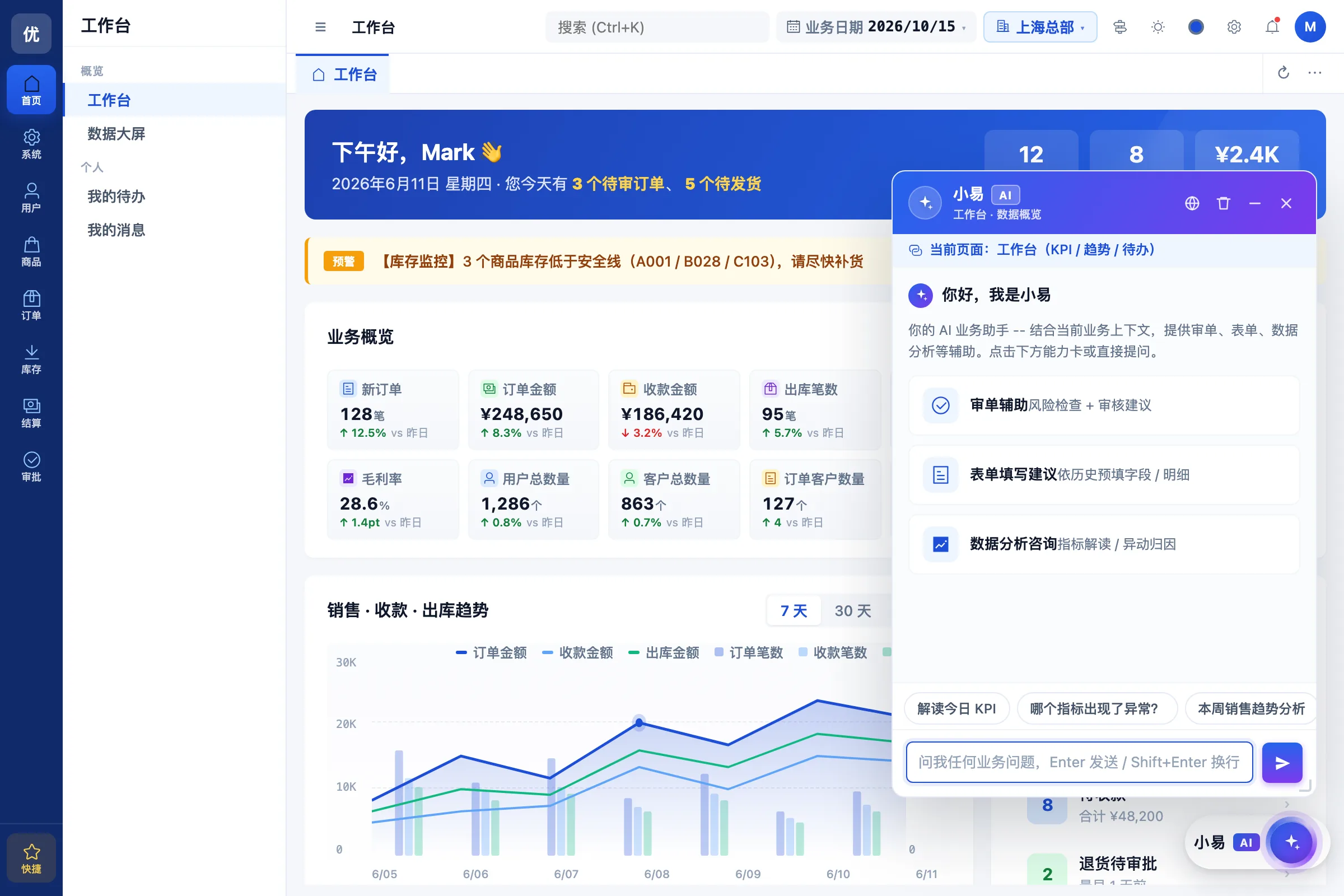
How we turned similar challenges into results
Private RAG knowledge base over policies and product docs — new-hire ramp-up down roughly 40%, support answers in minutes (sample data, unverified)
Industrial equipment manufacturer knowledge-base RAG Q&A: new-hire independent answering time from ~4 weeks to 2.5 weeks; support agents find answers in minutes (sample figures pending verification)
Read the case studyAI agent in WeChat Work and the mini-program handles about 70% of member and returns questions, first response in seconds (sample data, unverified)
Convenience-store chain customer-service agent: ~70% of routine inquiries handled automatically; first response from minutes to seconds (sample figures pending verification)
Read the case studyWe break "can we trust the AI?" down into verifiable engineering practices
| Commitment | How we deliver it |
|---|---|
| Hallucination control | Answers must cite sources, paired with faithfulness evaluation and traceability to the original text; the goal is to reduce, detect, and trace errors — probabilistic models cannot promise their complete elimination |
| Effectiveness validation | A golden test set before launch and regression tests on every change — results speak in data |
| Data security | RBAC permission and sensitive-content isolation; optional private (on-premises) deployment keeps data inside your network |
| Application security | Prompt injection protection (the top risk in the OWASP LLM Top 10) and output content filtering |
| Cost governance | Token usage monitoring and budget control; swappable models keep driving costs down |
| Human fallback | Shadow mode and staged rollout, automatic handoff to human agents on low confidence, human confirmation for critical decisions |
Compliance boundary: requirements differ between internal enterprise use and public-facing services. For public-facing scenarios we help customers complete a pre-launch compliance assessment; the filing obligor is the customer.
Phase-based acceptance: each phase produces documents for your sign-off before the project moves on — progress and quality you can verify.
Eight questions about enterprise AI adoption (with pitfalls to avoid)
Internal-only use (such as internal knowledge bases or agent-assisted support) and "providing generative services to the domestic public" fall under different regulatory requirements. Most internal scenarios carry no public-facing filing obligation, though individual cases leave room for interpretation and we do not treat this as an absolute conclusion. If a system will be opened to the public, we help customers complete a pre-launch compliance assessment during solution design — the filing obligor is the customer.
We manage hallucination as an engineering problem, not a verbal promise: answers must cite sources and can be traced back to the original text; faithfulness is tested against a golden test set before launch; questions outside the knowledge base are answered with a constrained scope or handed off to humans. The goal is to bring errors down to a business-acceptable level where they can be detected — beware of vendors who claim to be completely hallucination-free.
A simple rule: prompt engineering changes behavior, RAG supplies knowledge, and fine-tuning adjusts style and voice. For enterprise knowledge Q&A and policy lookups, RAG is almost always the first step — knowledge updates anytime, answers are source-grounded with citations, and costs are far below fine-tuning. Fine-tuning suits fixed-format outputs and domain voice, usually layered on after RAG as needed. We provide a combined recommendation during solution design.
No. Mainstream Chinese models such as DeepSeek, Qwen (Tongyi Qianwen), GLM (Zhipu), and Kimi are already common choices for enterprise scenarios, and several open-source models support private (on-premises) deployment. We make the model layer swappable, selecting by scenario fit and cost so you are never locked into a single vendor.
Three lines of defense: permissions — RBAC aligned with your org structure and sensitive content isolated by department; deployment — highly sensitive scenarios can use private (on-premises) deployment, where data and models run inside your network without passing through any third party; application — prompt injection protection and output content filtering.
It depends on the number of scenarios, your data foundation, and integration depth. We recommend starting with the POC from our 5-step method: validate effectiveness and cost on real data at small scale, then decide on full investment with real numbers. Tell us your current state and goals for a free initial proposal and quotation.
Operations and iteration is the fifth step of the method, not an option: effectiveness monitoring, knowledge-base operations (unanswered questions iterated weekly), and model and cost reviews are all written into delivery. Annual operations agreements with clear response terms and service boundaries are also available.
Four questions filter out most of them on the spot: first, demand a POC on your real data — no "PowerPoint delivery"; second, demand an evaluation baseline so quality has an objective yardstick; third, demand real production cases — ideally ones where the vendor relies on it in their own product; fourth, be wary of promises like "completely hallucination-free" or "guaranteed filing approval" — the limits of probabilistic models are industry consensus, and teams that state their limits plainly are the more credible ones.
Tell us where your business stands and what you want to solve — we will reply with an actionable scenario list, an initial proposal, and a quotation.